Built for teachers who want to know their students wrote their paper — not an AI's educated guess on AI.
AI detectors give confident verdicts that turn out to be wrong, and honest students pay for it. Red Stet gives each student a record of how they wrote, so they can show their work instead of defending themselves against a score.
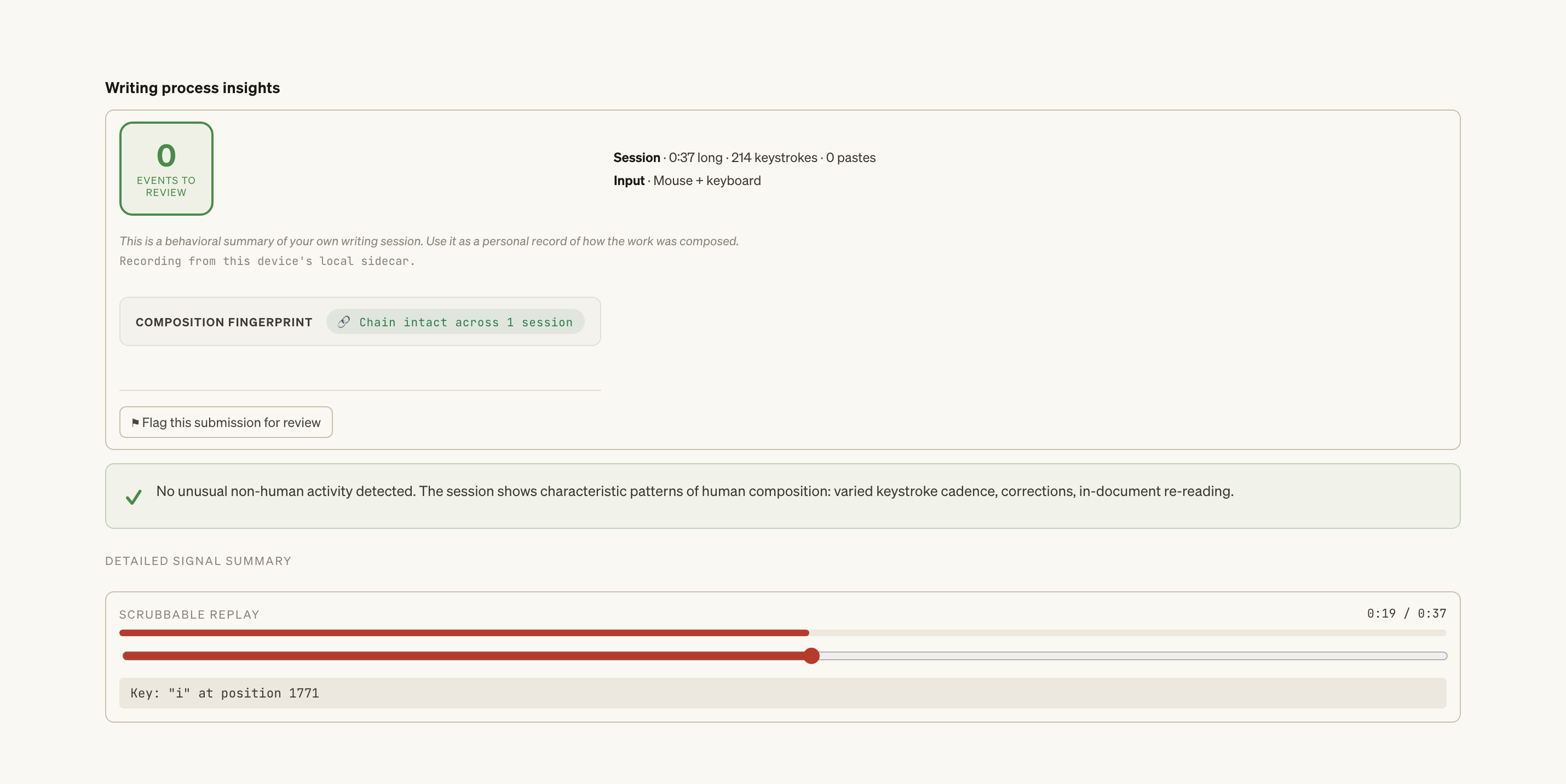
Red Stet shows you how each student wrote — not whether they used AI. You see the writing happen: the pauses, the corrections, the paragraphs that came together one keystroke at a time, the paragraphs that arrived as a single paste.
Your job is to ask about a specific moment in the record.
Today: if you ever get accused, you have the evidence. Red Stet records your writing process automatically — every keystroke, every revision, every late-night session — and packages it as a verifiable file you can show anyone.
Tomorrow: as AI tools become normal, your own writing voice is the thing that stays scarce. Red Stet is building your Writing Profile, year by year. Start in 9th grade. Carry it through college. Have proof of your voice — for the rest of your life.
The California Department of Education published its model policy on 25 June 2026, under SB 1288. Principle 2 sets the standard for handling suspected AI misuse.
Concerns about misuse must rely on educator evaluation of student engagement, alternative assessment, and documented evidence of authorship … with clear criteria for rebutting claims of inappropriate AI use made available to students and parents/guardians. — CDE Model Policy: Artificial Intelligence in Education, Principle 2
The same principle states that AI detection software must never be the sole basis for discipline. A district following the model policy therefore needs two things a detector cannot supply: documented evidence of authorship, and published criteria a student or parent can use to contest a claim.
Red Stet supplies both. The recording is the documented evidence — keystroke timeline, pasted text with time and position, revision history. A signed-in session is encrypted when the session ends. The written policy, the appeal route, the standard of proof, and the notice a student receives are set by your district and published to the people they apply to.
Red Stet produces no detection score, and it cannot open a case on its own. A case requires a teacher's own observation, independent of anything Red Stet reports. The record corroborates or contradicts that observation; it never originates it.
How it works, what it removes, what it gives back.
Students who sign up to Red Stet opt into the recording layer at account creation — same as any writer. As they write, the editor captures plain-text events inside the working surface: keystrokes, the text you paste, copy or cut, cursor moves, timestamps.
What does NOT get captured: no microphone, no camera, no screenshots, no screen recording, no clipboard text the student doesn't paste into the editor, no keystrokes outside the editor window. The receipt only sees the page the student is writing on. The recording can be flipped off per-doc by the student at any time.
When a student opens an assignment link, a separate consent fires — not to turn the recording on (it was already on from their sign-up), but to confirm they're sharing the receipt with you when they submit. A signed-in session is signed and encrypted when the session ends, and a public timestamp is requested then. Submission shares that recording with the teacher. Teachers see the document and the recording together. The two either line up, or they don't.
False-positive integrity cases. AI detectors produce confidence scores that turn out wrong often enough to wreck student records and faculty reputations. Red Stet doesn't produce a score. It produces a recording. There is no statistical guess to defend, and a flagged moment points at a specific event a student can answer.
Integrity-board cases that fall apart on evidence. Process recordings hold up where confidence scores don't. Your integrity board reviews verifiable evidence — keystroke timelines, pasted text, focus events — not a vendor's percentage they have to take on faith.
The cost of judging students on a guess. When a decision rests on an AI detector's score, your district owns the risk. With Red Stet, a question is about something specific the student can answer: this paragraph arrived as a paste at 2:14 AM. Where did it come from?
Teacher confidence. Your teachers can ask a student about a specific moment in their recording. The conversation is grounded in evidence both sides can see.
Student trust. Students see what teachers see. The same evidence. No black box, and no statistical confidence to argue with.
A multi-year writing record per student. Every student carries their Writing Profile across their years in your school — useful for honors programs, grade appeals, and college applications.
Detection tools made integrity boards adjudicate statistics. We give them evidence. — The Red Stet promise
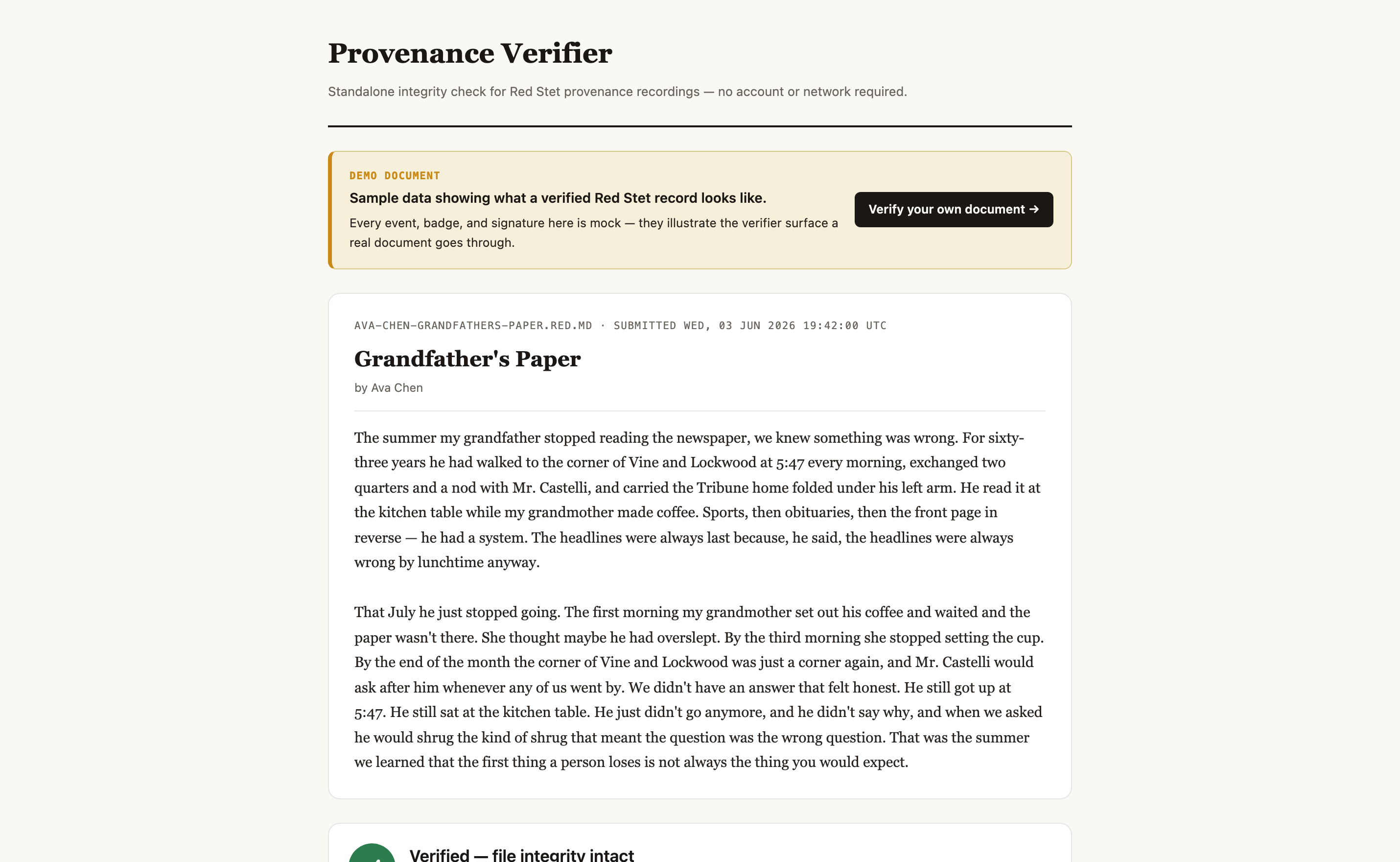
Process records, not statistical confidence scores. An integrity board can review the record itself.
Students see what teachers see. The same evidence. No black-box detector flagging them with no recourse.
Every student you license carries a Writing Profile across their years in your school. A multi-year record of writing development your honors programs, grade appeals, and integrity board can rely on.
Detectors and Red Stet answer different questions.
AI detectors are statistical guesses. They run text through a model and produce a confidence score. They're wrong often enough that universities are walking away from them.
Red Stet doesn't guess. We record. The teacher sees the actual writing process. They see the paragraphs that came together one keystroke at a time and the paragraphs that arrived as a single paste. They see the pauses, the corrections, the natural rhythm of a writer thinking on the page.
Then they make the call — their judgment, supported by evidence rather than a percentage.
And we don't sell the AI tools that would launder our own verification. We make one product.
| Red Stet | AI detection tools | |
|---|---|---|
| What you get | The actual writing process | A confidence percentage |
| False positives | No statistical score to be wrong | Routine and documented |
| Defensible in integrity hearings | Yes — verifiable evidence | Often dismissed |
| Conflict of interest | None — we don't sell AI tools | Several major vendors sell both AI and detection |
| Student-facing trust | Students see what teachers see | Black box — students can't review the basis |
A multi-year writing identity that follows each student through your school.
Every student writing in Red Stet builds a personal Writing Profile — their typing rhythm, revision patterns, vocabulary growth, the way their sentences open. By graduation, they have years of authenticated writing behind them.
The profile is preserved indefinitely. While your students are enrolled at your school, they have full access on your dime. After graduation, they have the option to continue with a personal subscription. Either way, the record persists — and verifies offline through our standalone tool, free, no account required, forever.
The voice you write in today becomes a record you carry forward. The further back the record goes, the harder it is to dispute. — The Red Stet pitch to students
Detection failed. False positives broke faculty-student trust. Red Stet doesn't repeat the mistake.